I didn’t think I’d need to write this post, as there have been extensive critiques of ABA from many autistic people before. However, I am concerned by the rise of people trying to rebrand ABA as ‘neuroaffirming’, which I don’t think is being talked enough about or called out. So here is why ABA will never be ‘neuroaffirming’ and it is incredibly damaging to claim it is!
The term ‘neuroaffirming’ has been increasingly popular in more recent years, and as a concept it’s certainly still in its infancy. I wouldn’t say there is a widely accepted definition of neuroaffirming yet, but in essence it ensures we are accepting people for their neurodivergence, over pathologising human differences with how our brains work and how we experience the world. It’s about supporting neurodivergent people with challenges they may face without trying to fit them into the box of social norms. The attempts I’ve seen so far to define neuroaffirming have only been in an autism context, rather than the full breath and variety of neurodivergencies (BPS, 2024; Flowers et al., 2025).
However, unfortunately I’ve also come across the people claiming there is such a thing as ‘Neuroaffirming ABA’ or that the ‘New ABA has been reformed’. ABA is short for Applied Behaviour Analysis, a compliance based “therapy” which was seen as the go to “autism treatment” (no such thing exists) based on the same ideology as gay conversion therapy (Gjerde, 2025). The “father” of ABA was Ole Ivar Lovaas who rewarded autistic children for performing neuronormativity and punished them for showing any visible signs of neurodivergence. This is referred to as operant conditioning (NeuroClastic, 2021), a principle which Lovaas also applied to the development of conversion therapy and more specifically, The Feminine Boy Project. The goal was to pressure people into conformity around social norms, gender and sexuality.
Lovaas himself also did not recognise autistic children as human, take his own words for it.
“You see, you start pretty much from scratch when you work with an autistic child. You have a person in the physical sense—they have hair, a nose, and a mouth—but they are not people in the psychological sense. One way to look at the job of helping autistic kids is to see it as a matter of constructing a person “You have the raw materials, but you have to build the person.”
(Lovaas interview quote. Chance, 1974)
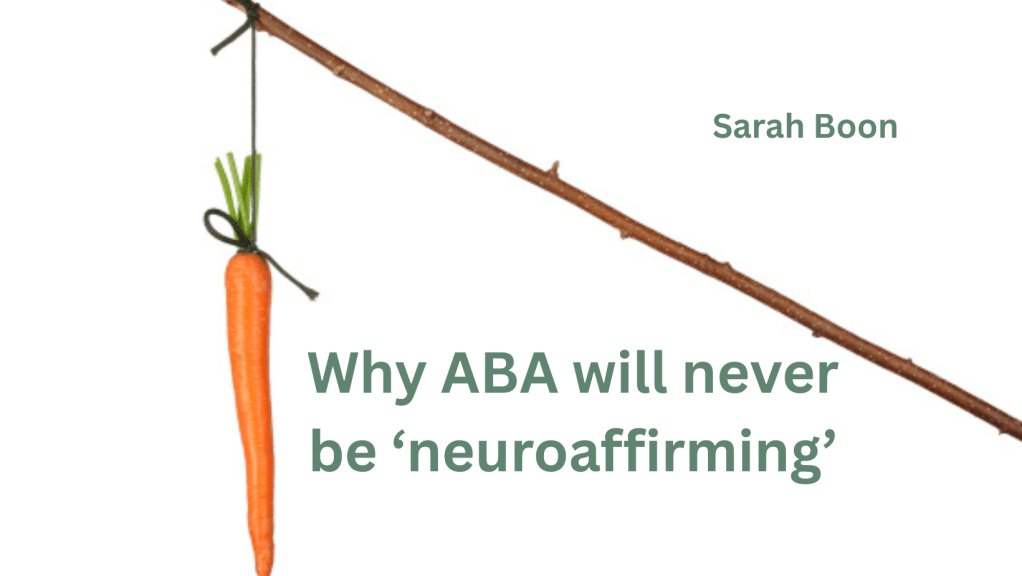
As you can see, the lack of acceptance of autistic people being themselves is within the foundations of ABA (and other behavioral therapy that relies on operant conditioning). Along with its founder’s dehumanisation of autistic people, Lovaas and his approaches automatically see differences as a problem that can be “fixed” through a carrot and stick approach. No considerations for how the person views their own differences and if at all they want to make any changes in their life. It may be no surprise that there is emerging evidence which identifies a correlation between autistic people subjected to ABA and PTSD symptoms (Kupferstein, 2018) when we examine the roots of ABA.
There is also a lack of adjustments made for people and accommodating for disabilities which many people experience through their own neurodivergence. Clearly this does not align with current discussions as to what neuroaffirming practices involve. Some even go as far to say rejecting ABA and compliance based “therapies” are essential for neuroaffirming practice and go against human rights (BPS, 2024).
But often when people call out ABA for its harmful foundations, defenders will proclaim punishments aren’t used anymore and will believe that “new” and “reformed” ABA is not like it used to be (Lieu, 2021). I mean claiming the approach no longer involves abusive punishments that were inflicted on children is a pretty low bar. Plus it rarely occurs to ABA defenders that rewarding behaviour (or positive reinforcement as they call it) can cause harm too.
Rewarding autistic children for acting more “normally’’ often comes at great emotional cost, and is incredibly draining for the individuals who are subjected to it. It essentially rewards autistic people for hiding their authentic selves, meaning people are often navigating the world in a way which is completely unnatural for them, and social acceptance is conditional based on conforming to interacting “normally”. This is often called autistic masking or camouflaging.
Accepting people for their differences and recognising that communication is always a two way street doesn’t seem to factor in here or tries to establish mutual understanding. If one person is forced or pressured into completely changing themselves for the most basic level of respect, then that is harmful. That’s before we even look into the research that’s uncovering the significant consequences on autistic people’s mental health who mask and camouflage (Pérez-Arqueros, 2025). So if ABA rewards behaviours that lead to autistic people masking and camouflaging then we’re essentially putting people on a pathway to mental distress and suffering.
So don’t buy the argument that ABA which only involves positive reinforcement is neuroaffirming, because it isn’t. It does not accept people for who they are and forces them to comply with normality through positive reinforcement.
Not to mention the recent evidence which unveils Lovaas’ links to the Nazi party during his youth and the possible influence it had later on when he developed ABA. The paper which investigated these links concluded
“Ultimately, the purpose of this article has been to establish a correct set of facts about the teenage years of Ole Ivar Lovaas. Although the significance of these years to his later career as a pioneer of ABA interventions for autistic children is unclear, the fact that Ole Ivar Lovaas was a local leader of a fascist and collaborationist youth movement, and the son of a major Nazi propaganda official, is likely to be of interest to students of the history of autism and of behaviourism.”
Gjerde, Å. B. (2025)
If you even have to question how much ABA was influenced by Nazi ideology, then it’s crystal clear it’s something that is far beyond any sort of reform. Even if only some evidence has been found relating to this at the time of writing, some things cross a hard line and in this case it certainly does. Nazis were not accepting of neurodivergent people, with many being euthanised as part of the T4 programme when the Nazi’s were in power (Czech, 2018). Any form of “treatment” or “therapy” which has a history like this is incompatible with neuroaffirming care, including if it’s allegedly been “reformed”.
If you enjoy my writing or would like to support my online advocacy work, I would be forever grateful if you could buy me a coffee (or tea in my case).
You can also support the blog by purchasing my book ‘Young Autistic and ADHD: Moving into adulthood when you’re multiply neurodivergent’.
Relate Blog post:
Does neuro-affirming always live up to what it’s cracked up to be?
References:
BPS (2024). What does it mean to be neurodiversity affirmative? Available at: https://www.bps.org.uk/psychologist/what-does-it-mean-be-neurodiversity-affirmative.
Chance, P. (1974) ‘A Conversation With Ivar Lovaas’, Psychology Today: 76–7, 79–90, 82–4. Scanned copy accessed via Wayback Machine. (2024). Archive.org.
https://web.archive.org/web/20210616170942/https://neurodiversity.com/library_chance_1974.pdf
Czech, H. (2018) ‘Hans Asperger, National Socialism, and “race hygiene” in Nazi-era Vienna’, Molecular Autism, 9(1). Available at: https://doi.org/10.1186/s13229-018-0208-6.
Flower, R. L., Benn, R., Bury, S., Camin, M., Muggleton, J., Richardson, E. K., Bulluss, E. K., Calabria, B., Curran, A., Giugni, M., Gottliebsen, V., Hodges, H., Lawrence, J., Leung, V., Levy-Knoll, R., Miklosi, K., Mitchelson, M., Nuske, A., Waldie, C., & Watts, C. (2025). Defining Neurodiversity Affirming Psychology Practice for Autistic Adults: A Delphi Study Integrating Psychologist and Client Perspectives. Autism in Adulthood. https://doi.org/10.1089/aut.2024.0305
Gjerde, Å. B. (2025). Hidden Nazi past: Ole Ivar Lovaas during the German occupation of Norway. History of the Human Sciences. https://doi.org/10.1177/09526951251324102
Kupferstein, H. (2018). Evidence of increased PTSD symptoms in autistics exposed to applied behavior analysis. Advances in Autism, 4(1), pp.19–29. doi:https://doi.org/10.1108/aia-08-2017-0016.
Lieu, L. advocate of L. of et al. (2021) I Was Part of the ‘Good ABA’, NeuroClastic. Available at: https://neuroclastic.com/i-was-part-of-the-good-aba/.
NeuroClastic (2021). What is ABA? Available at: https://neuroclastic.com/what-is-aba/.
Pérez-Arqueros, M. et al. (2025) ‘Camouflaging and suicide behavior in adults with autism spectrum condition: A mixed methods systematic review’, Research in Autism, 121-122, p. 202540. Available at: https://doi.org/10.1016/j.reia.2025.202540.
 Sarah Boon
Leave a comment