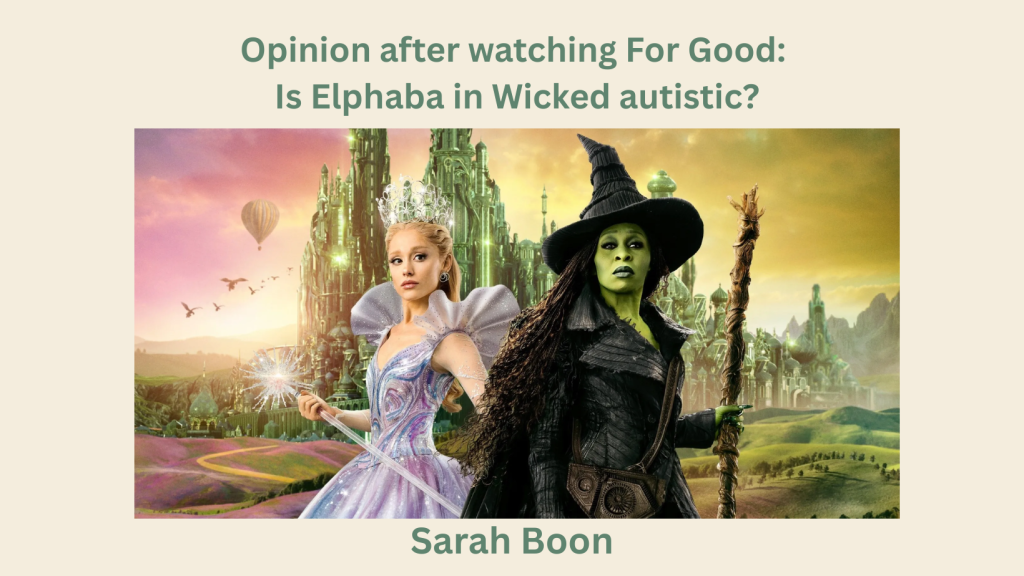
CW: Minor Spoilers
Last year, after watching Wicked Part 1 and seeing conversations suggesting that the lead character Elphaba could be autistic, I decided to throw in my own two cents. I have been a fan of the musical for a long time, and way before I even knew I was autistic myself! As it’s been about 15 years since I last saw the musical before the release of Part 1, I certainly watched the film with a new lens and considered whether Elphaba could be autistic. Several people were claiming online that she was an autistic head cannon (meaning some fans believed she was autistic even though it’s not officially confirmed).
By the end of Wicked Part 1, I concluded that Elphaba isn’t autistic, but her marginalisation parallels many of our experiences as autistic people. Also, it is not just autistic people who relate to how Elphaba was discriminated against in Part 1; people who are part of other marginalised groups do too, it’s not just unique to being autistic. However, I did feel that being autistic made Elphaba a more relatable character for me personally. If you haven’t read my original blog post from last year, ‘Opinion: Is Elphaba in Wicked autistic?’ I’d recommend reading that first to catch up on my full views before proceeding further with this post!
Now that the second part, Wicked For Good has just been released, I thought I’d revisit the question while watching the new film, to see if my views remain the same as last year or if they have indeed changed for good (pun intended).
By the time the credits rolled up in the cinema, there was nothing new that convinced me that Elphaba is autistic, so I am still saying she isn’t. However, there were still moments Elphaba had during Wicked For Good that mirrored some of my experiences of being autistic. Starting off, she is isolated from nearly everyone, and there have been times when I have been isolated myself due to how my differences have been misunderstood. Even though the differences that isolated me were not the same as Elphaba’s. I am not going to give a full analysis of the ins and outs of how I became isolated differs from Elphaba, as that is too personal information to share online! Thankfully, I am not isolated or experiencing any loneliness now.
Back to Wicked! One lyric which stood out to me, sung by Elphaba during the opening song, was “How I saved them from the Wizard, by revealing he’s a fraud. If I can just make them believe in the truth, that all that he says is a lie. That’s when they’ll finally bid the Wizard goodbye”
She seems hyper-focused on shedding light on the truth. Many autistic people experience monotripism, which explains how autistic people can focus in great depth on one area, but struggle or are unable to switch their focus to anything outside of that. During the whole film, her main focus is to expose the Wizard to free the animals oppressed in Oz. Granted, she does get sidetracked a few points during the film (I won’t spoil it here), but I could see how some people would interpret that as part of a monotropic focus. Then again, it is not just autistic people who experience monotropism, so that wouldn’t automatically lead me to rush to the conclusion that she is autistic.
Some may also put this down to the inaccurate stereotype that all autistic people have a “strong sense of social justice”. Yes, some do, but not everyone. I think it’s more accurate to say that a lot of autistic people can feel strongly about their personal subjective view of what is fair or not. And sometimes that person’s perception of fairness is immoral and opposes social justice. Take Elon Musk as a prime example. Also, there are plenty of non-autistic people out there who do have a strong sense of social justice. So the fact that Elphaba does have one isn’t a notable sign of autism either.
However, there was nothing else that stood out to me as obviously autistic in Elphaba’s character during Wicked For Good. There were no obvious sensory differences, trying to work out and think through how to communicate with others or needing any sort of support with daily living. In fairness though, a lot of the difficulties autistic people can experience during daily life would be solved if we had magical abilities (which we don’t in reality). So I guess you could argue that her magic in the film may help disguise the difficulties she may have otherwise experienced in these areas, but that seems a bit of a stretch for me.
The major friendship issue that really rears its head is over a boy. Again, that’s not really any autism related thing that comes up in friendships; it’s more of a general teenage girl one. That said, by the end of Wicked For Good, I did feel Elphaba and Glinda’s friendship was more genuine and didn’t remind me of some of the more tricky experiences I had with friendships as an autistic person that came up in Wicked Part 1.
So overall, my opinion remains that Elphaba isn’t autistic. What I found Wicked For Good did do was affirm my position on this, but also demonstrated more examples of how the difficulties and discrimination autistic people often are subjected to are comparable to Elphaba’s.
If you’re autistic, do you agree? Or do you still think she’s autistic? Let me know in the comments below.
If you enjoyed this post and like to support my writing, I would be forever grateful if you could buy me a coffee (or tea in my case) on Ko-fi.
You can also support the blog by purchasing my book ‘Young Autistic and ADHD: Moving into adulthood when you’re multiply neurodivergent’.

 Sarah Boon
Leave a comment