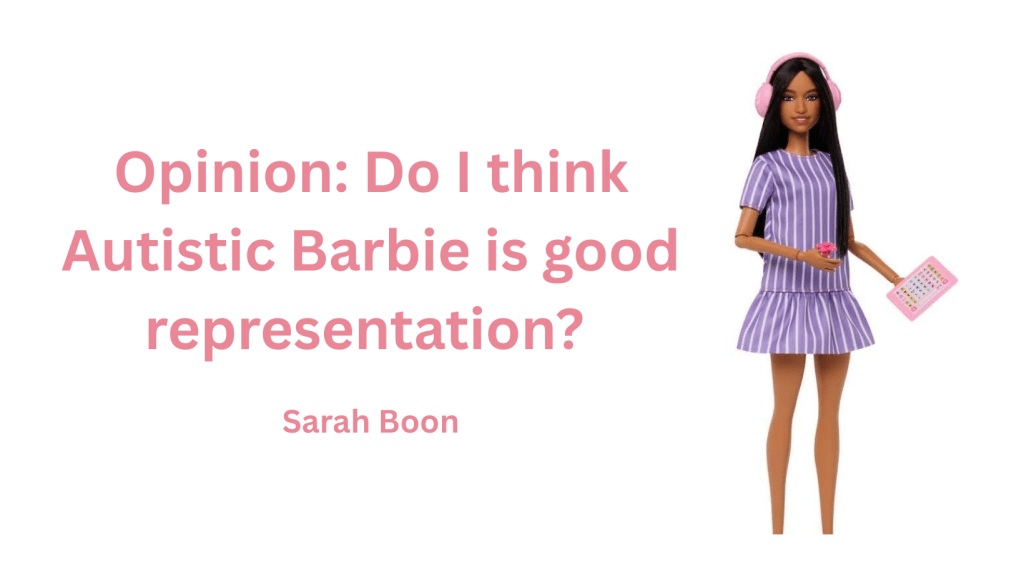
If you were on social media on Monday morning (12th Jan 2026), then you will have likely seen the announcement by Mattel but they are launching an autistic Barbie. Since this announcement there has been a flurry of opinions all over the Internet both praise and criticism from autistic and non-autistic people alike.
When I first saw there was an Autistic Barbie, my first reaction was delight. I thought that this is such a cool way to introduce autism in a positive light to young children at an age where they are most impressionable. Granted, having an Autistic Barbie alone won’t be enough to address all the stigma around autism but it feels like a step in the right direction for the next generation. If this is a baseline of their understanding of autism, then it’s certainly a heck of a lot better than the Autism Speaks adverts of the early 2000s.
When it was shared about how Autistic Barbie was co-produced with autistic people and an autistic led self advocacy organisation, I was reassured to see the steps taken to make Autistic Barbie authentic. We talk about co-production a lot when it comes to autism, but from what I can see (granted I don’t know the full ins and outs here), it looks like they took it seriously and did it in a meaningful way.
I also think Autistic Barbie helps challenge some of the common images that come into people’s minds of what an autistic person looks like. There’s no one look an autistic person has, but what people often assume an autistic person to look like is a young white boy who loves trains. Yes there’s some autistic people who tick those boxes but most of us don’t. However, Autistic Barbie is very different from the stereotype. I hope the launch of Autistic Barbie will help diversify people’s perceptions of what autistic people can look like.
No one Barbie will ever be able to represent every single autistic person entirely (that’s impossible with how much of a diverse group autistic people are). However, how Autistic Barbie has been presented does challenge the narrow stereotypical image of autism. The only way we can get a fuller representation of autistic people here is if we have multiple Autistic Barbie’s, and maybe that will happen in the future.
Autistic Barbie’s announcement made me think of how I would’ve responded to this Barbie as a child. I think it would’ve helped me be more accepting of my communication differences, specifically around eye contact from a young age. I remember having to self monitor my body language, facial expressions and how I gave eye contact to fit in and mask my autism. Autistic Barbie is the first of its kind where the eyes are not directly looking ahead to represent this communication difference. There’s no doubt my Barbie dolls had a big influence on me as a child. Seeing differences in eye contact represented in a toy that me and the other kids would have played with may have taken off some of the pressure I had around giving eye contact. As we all would’ve learnt eye contact is not the be all and end all for meaningful communication. I’m hoping the release of Autistic Barbie will support the growth in accepting autistic communication differences in the years to come.
Another thing I will add is that Autistic Barbie feels an improvement on representation of difference by Barbie before. Just a few years ago in the Barbie film, Weird Barbie’s character was an analogy of the mistreatment many autistic people face in society. And that’s the closest we had of autistic representation within the Barbie brand before today. I wrote about this previously in my blog post ‘Weird Barbie and Autism, Let’s Talk’ .
Although it’s vital we acknowledge the societal discrimination autistic people face, we also need to see autistic people being able to live their best lives and destigmatise autistic individuals for our differences. Something about Autistic Barbie seems to do this a lot better than the representation of Weird Barbie in the Barbie film.
My take is that Autistic Barbie is a great example of a more authentic and inclusive representation of us. Sure there is still further to go, but from my point of view, Autistic Barbie is a positive improvement in representing autistic people.
What are your views on Autistic Barbie? Let me know in the comments!
If you enjoyed this post and like to support my writing, I would be forever grateful if you could buy me a coffee (or tea in my case).
You can also support the blog by purchasing my book ‘Young Autistic and ADHD: Moving into adulthood when you’re multiply neurodivergent’ .
 Sarah Boon
Leave a comment