Trigger warning: School trauma, ableism, bullying
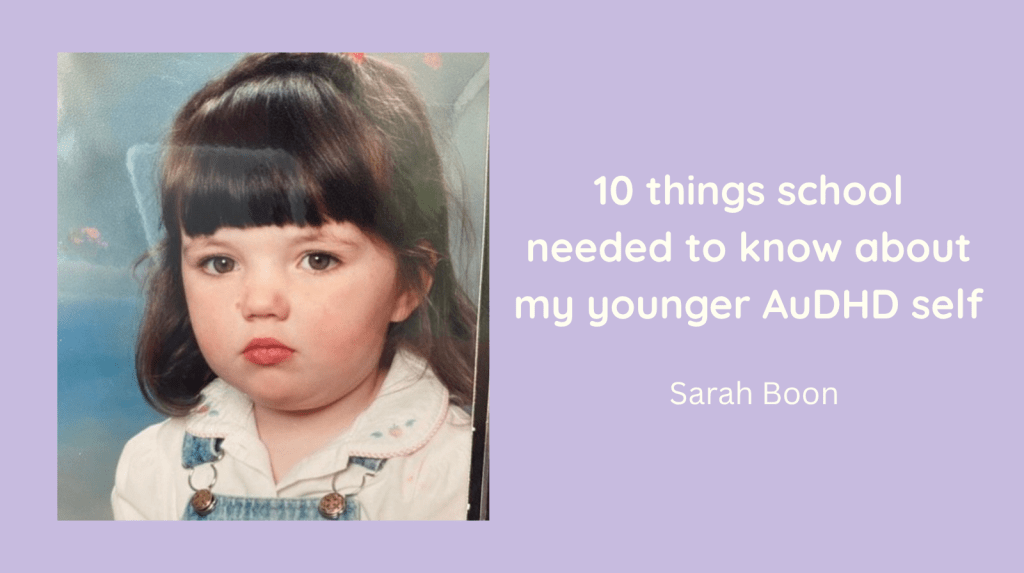
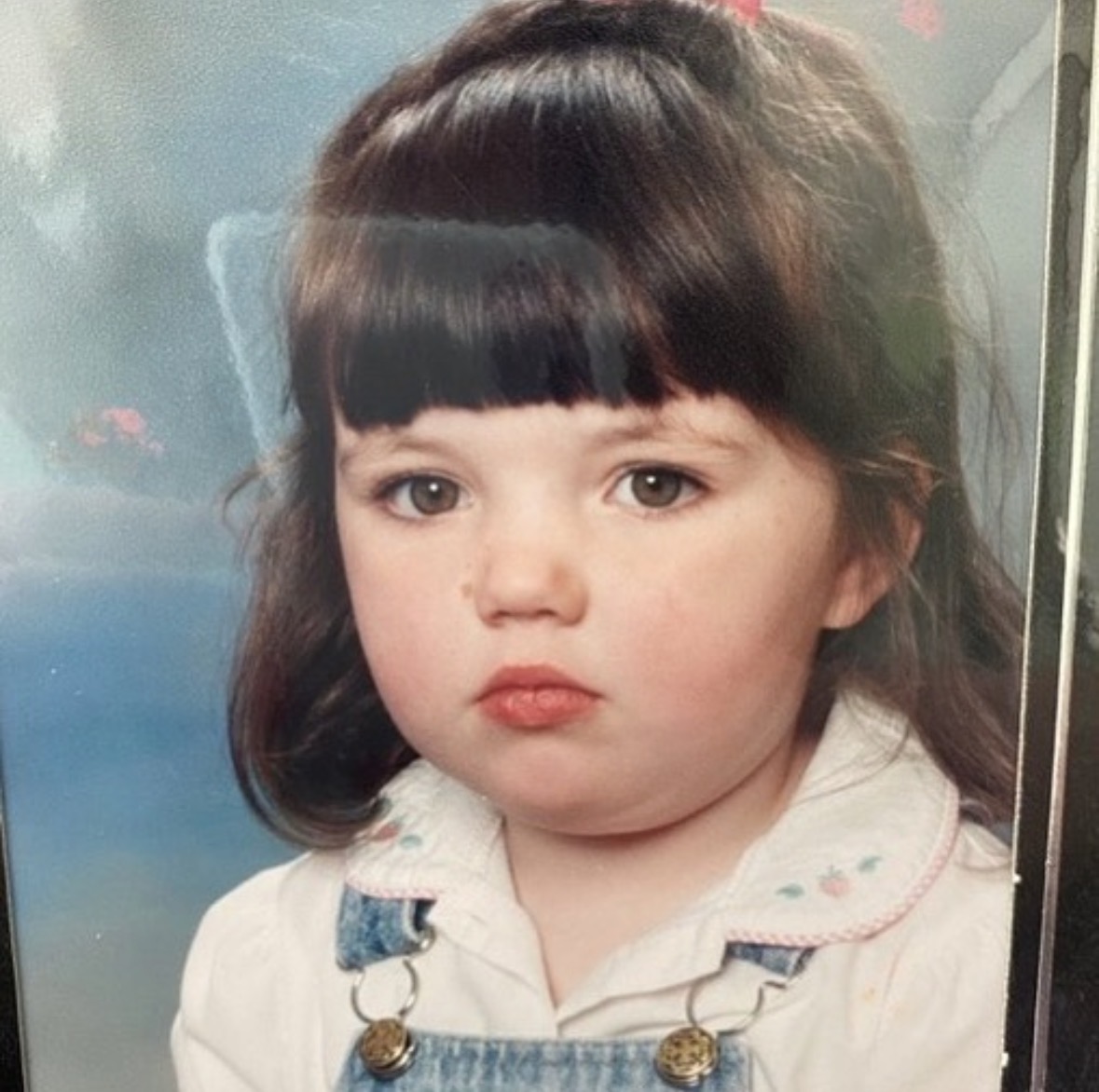
As the beginning of September is creeping up on us, it is back-to-school time in England. I’m grateful to say that my school days are behind me and I won’t be returning to school again. I had an incredibly rough ride through my school years with being AuDHD. As you can see in my first school picture featured in the cover photo for this post, I was far from happy at school. Although I was undiagnosed at the time, I am sadly not convinced having a diagnosis then would have automatically made things better.
And from what many neurodivergent people are sharing, including AuDHD peeps, it appears very little (if anything) has changed in the English school system since I left. So I thought now would be a good time to reflect on 10 things that I think would have made my school days a lot better. It didn’t have to be this way, and to be honest, it still shouldn’t be relevant now!
However, I am a believer in having conversations about how we can improve our world for neurodivergent people in all kinds of ways, including education. So whether you’re a teacher seeking to better understand your neurodivergent students, a parent wanting to understand how your child can be supported in education, or you’re an AuDHDer exploring how you can self-advocate at school, then I hope my top ‘10 things school needed to know about my younger AuDHD self’ can help answer some of your questions.
1. School’s idea of what engagement looks like doesn’t align with my reality.
If there’s anything that stands out from my school days, it was the obsession around students “showing like they were listening“ to authority figures.
What was actually meant by this was the neuronormative standard of assuming that listening looks the same for everyone, which included our eyeballs directly focusing on the person instructing us or what they were showing us on the whiteboard. And perhaps more importantly, sitting as still as a lifeless object.
My mind had other ideas, and still does to this day. I am unable to concentrate while sitting still and having a direct gaze towards one small specific area (or person) over a prolonged period of time.
I fidget and doodle so I can maintain focus. However, this was viewed as the opposite of “listening”. School rules didn’t stop me from doing this, it just taught me ways to hide my needs so that I had the ability to concentrate. Although my easily distractible mind wanders off in different directions, this was actually an opportunity for me to develop my creativity. Sadly, neuronormative school environments rarely accommodate space for learning in this way.
2. School told me to ask more questions…but it wasn’t safe for me to do so.
One of the biggest criticisms I received during my school years was “she needs to ask more questions”. However, it was never as simple as me just asking them, because the questions you ask may be outside of what is received as an acceptable question; it becomes risky to ask.
Whether that’s other students bullying you for asking something that may seem obvious to them, or teachers thinking I was being rude when really I was just trying to clarify what’s going on.
Regardless of the number of times you’d hear school staff say “ there’s no such thing as a stupid question”, I learned very quickly that the reaction did not align with this alleged value of the school. On top of the other issues I experienced at school, it became very clear that it was not safe for me to ask questions in any form, as I was too vulnerable in that environment to potentially expose anything that may be perceived as a weakness by others (even if that wasn’t actually the case). The type of questions I would ask were often easily misinterpreted, which others sought to take advantage of.
So for me to be able to ask more questions, school needed to become a psychologically safer place for myself. Which school did nothing about for the duration of my time there.
3. Just because I’m “perfectly behaved” doesn’t mean I’m doing okay.
Due to bullying and having to navigate a million unwritten rules (which I didn’t get the memo about), navigating the school environment was a nightmare, and I was in survival mode for most of the time. When you’re in survival mode, you do the thing that you believe will keep you the safest and avoid conflict; for me that led to me being perceived as a “perfectly behaved student” who followed the rules, as part of a fawn response. As a scared child, I couldn’t see any other options for myself during those years.
It’s fairly clear that if you spent any time with children, a lot of growing up is testing the boundaries and learning where the line is. It’s only as an adult I’ve realised what an important part of development that was, and how I actually missed out on that due to being in a fawn response throughout school. I believed if I shrunk myself so I was “easier for others”, then that would make my school life slightly more comfortable and avoid even more difficult situations.
It didn’t, and it only added to my vulnerability and distress as an AuDHD person in a mainstream school.
4. School keeps praising me for things that are adding to my distress.
Because I was perceived as “perfectly behaved”, I was often praised for this, which at the time only made me do this more. However, being perfectly behaved the whole time as a child isn’t realistic. It added to the pressure to strive towards this even more, which actually did a lot more harm than good.
The pressure to be perfect was rife, especially as I viewed my differences at the time as a problem to be fixed. It was clear to me that my authentic self wasn’t going to be accepted by nearly everyone in school. By both students and staff. I had to pretend to be someone so distant from the real me, which took an enormous amount of effort. Far too much to be expected of any young person or child in hindsight.
This is what created the distress and ignited a cycle that I don’t know I’ll ever fully break free of, even as an adult.
5. I’m not inferring the same meaning from the text because I understand language differently.
Okay, so this one comes from reading my old Year 6 reports recently. And let’s say my English teacher at the time had a particular bone to pick with me around “not inferring hidden meaning between the lines”. And I would say to the point where it was appearing to be rather triggering for the teacher (reading between the lines of the school report as an adult now).
Anyway, to me now this is a clear example of being autistic and often having a different interpretation of social information, including the tendency to interpret information more literally. However, although I can’t remember the specific ins and outs of how this played out in the classroom all those years ago, I do wonder if there’s something around their being one interpretation as being seen as more acceptable than another. More specifically in this case, perhaps a neuronormative one?
If becoming a writer in adulthood has taught me anything, there’s rarely a single interpretation of our words. More often than not, interpretations don’t fit into clear, distinct categories of correct or incorrect. Especially if we’re thinking about fiction here. Perhaps there was limited creativity within the curriculum of how others’ writing was represented to us. Or what was seen as the correct interpretation…
I suspect this is still something that plays out fairly frequently for some autistic students in English class!
6. Actually, if school staff can communicate more literally, that would be great!
Often when you’re neurodivergent, there’s an expectation that’s placed on us that we have to fit into the norms with no exception. Rather than people trying to meet us in the middle, acknowledging the communication differences we may have and finding ways to bridge the gaps where these differences exist would be a lot more helpful.
So although my more literal interpretations weren’t appreciated in my English classes, what would’ve helped my understanding was more direct communication when interacting with me. When things are indirectly implied, the meaning of others’ words can become meaningless to me, and those unwritten rules become ever so much blurrier. Sometimes all it takes to be more inclusive is small adaptations to how teachers communicate with us. It’s not rocket science!
7. Don’t get frustrated with me when I don’t fit the one-size-fits-all approach.
Many are frustrated by the one-size-fits-all approach that is often delivered in our schools due to limited resources and funding. I totally understand that there are real challenges there.
However, something that did happen was that when I was struggling to learn in the way that was being prescribed, teachers’ frustrations were taken out on me for not fitting their mould. I could see the tension building up in them. I could hear it in their tone of voice, and the general approach towards me changed.
I think what got lost in those situations was that it wasn’t my fault that I was being subjected to a one-size-fits-all system that was hostile towards my neurodivergence. What I needed from teachers in those moments was understanding, compassion, and adapting as much as they could in the classroom to help meet my needs. Ultimately, I needed them to be my ally in a difficult situation, but this was rarely the case.
8. There’s a cultural problem for anybody who exists outside of “normal” within our schools.
The societal obsession we have with normality plays out in schools a heck of a lot of the time. And that was no different for the schools I attended, both from teachers and students.
It’s a big reason why I felt that need to hide my neurodivergence to fit in. Although I gave it my maximum effort possible to survive school, it was impossible to hide it all. Essentially, I was bullied into being as normal as possible. Even though not a day went by free of bullying, I do know that if I didn’t hide myself as much as I did, it would’ve been a lot worse and intensified.
That’s a trauma I still carry myself today, and the culture of the school did nothing to accept the differences that existed among students. Teachers and schools must play their role in valuing the differences students may have amongst themselves as a group, and that includes all differences beyond, and where it intersects with neurodivergence as well.
9. I picked up on that “she tries hard…” was a euphemism for something else….
So many of my parents’ evenings and school reports commented on the amount of “effort” I put into school. Part of this was naturally part of the “needing to be perfectly behaved” fawn response to survive a traumatic environment I couldn’t escape. Putting effort into schoolwork (or at least appearing that way) seemed like one of the easiest ways to achieve this at the time.
However, when I received these comments…there was always a but….
Basically, I was being told that my efforts were not enough, despite “trying hard”. And when you are hearing that message as a child, especially one trapped in people-pleasing behaviour, it was crushing. The messages that consistently came through from these comments were “no matter how hard you try, it is never enough”. And with nobody counteracting these implications, it made me believe a lie about myself: that I was incapable and I couldn’t accomplish anything, even when I put my mind to something. As a child hearing this and not knowing any different, my self-esteem definitely took a huge hit.
As I have always been AuDHD (and neurodivergent in other ways), learning in the way prescribed by school wasn’t accessible to me, and meant that I definitely did not have the opportunity to reach my full potential in school. It’s only as an adult that I discovered that I was academic; school’s ways convinced me of the complete opposite. By having the freedom to learn in a way that is better for me, I have developed my academic abilities beyond what people anticipated about me during childhood.
10. Never underestimate me because of my neurodivergence, or any other neurodivergent student for that matter!
I was underestimated in terms of my abilities because my differences did not allow me to fit the mould set out by the schools I attended. Sadly, it did not allow me to discover my strengths, and I do feel I was put in a box as a result. I also remember being discouraged from pushing myself further in certain subjects because of this (when actually that is what I needed as a student to develop). The box school put me in then determined their view of my abilities and suggested that I should settle for their limited and narrow understanding of what I could do.
All I can say is I am so grateful this never became a self-fulfilling prophecy in the long term. It easily could have been, and I sadly suspect it still will be for many neurodivergent people who struggled in school. Just because I didn’t fit schools’ version of success didn’t mean I was incapable. But I was treated that way for my differences and perhaps because I faced multiple challenges that many of my peers at the time did not.
Just because the differences I have are often unaccommodated for in this world doesn’t mean I was destined to be a failure or could only enjoy a limit verison of success. But that is what the school system made me and my family believe. Which is unforgivable in my eyes.
A neurodivergent child may not fit school’s typical ideas of success, but that doesn’t mean they are automatically incapable or unworthy. The school environment is often far from ideal for many of us, so even if you can’t see our strengths come out in school, that doesn’t mean we have none. Never underestimate a neurodivergent student during school and what your impression of them may mean for the rest of our lives, especially if they are in an environment which is far from ideal.
Final thoughts
My top ten list is based purely on my personal experience of the English education system. Even among AuDHD people, our experiences and needs in school will vary.
If you are AuDHD too, or neurodivergent in any other way, I’d love to hear your thoughts on whether anything resonated in my post with you? Or if there were other things that you felt school needed to better understand about yourself? Please let me know in the comments!
If you enjoyed this post and like to support my writing, I would be forever grateful if you could buy me a coffee (or tea in my case).
You can also support the blog by purchasing my book ‘Young Autistic and ADHD: Moving into adulthood when you’re multiply neurodivergent’.


Leave a Reply